Superconducting Reference Designs for Data Centers
A data center reference design is an engineered baseline that project teams adapt to their own site. It defines the layout, equipment, and performance attributes up front. Owners, engineers of record, and EPCs can then agree on capacity, redundancy, and cost earlier and reach detailed design with fewer engineering hours.
VEIR’s reference designs are the first in the industry to bring that approach to superconducting power delivery. Each covers the full power path from transformer to whitespace, including site-level heat rejection for both the IT load and the liquid nitrogen plant, and benchmarks against a conventional copper design. VEIR defined the scope and superconducting integration, and Jacobs Engineering Group engineered each design.

Proven Design Practice, Reengineered for Superconductors
For each reference design, Jacobs first engineered a conventional copper baseline using the materials and methods found in today’s AI data centers. The superconducting design holds the same criteria and replaces selected copper feeders with superconducting feeders, so in the compact power architecture designs the comparison isolates what superconducting power delivery changes on a project. In the decoupled power architecture designs, the transformers move away from the building, showing a layout that is impractical with conventional copper conductors.
Each reference design summary covers:
- Basis of design and system specifications
- Superconducting system overview: conductor assembly, terminations, cooling, controls
- Electrical architecture, redundancy, and feeder specifications
- Thermal system, including the liquid nitrogen plant and its redundancy
- Controls, BMS integration, and VEIR services
- Results against the copper baseline, schedule drivers, and LIN plant scaling
- Full design package contents and next steps
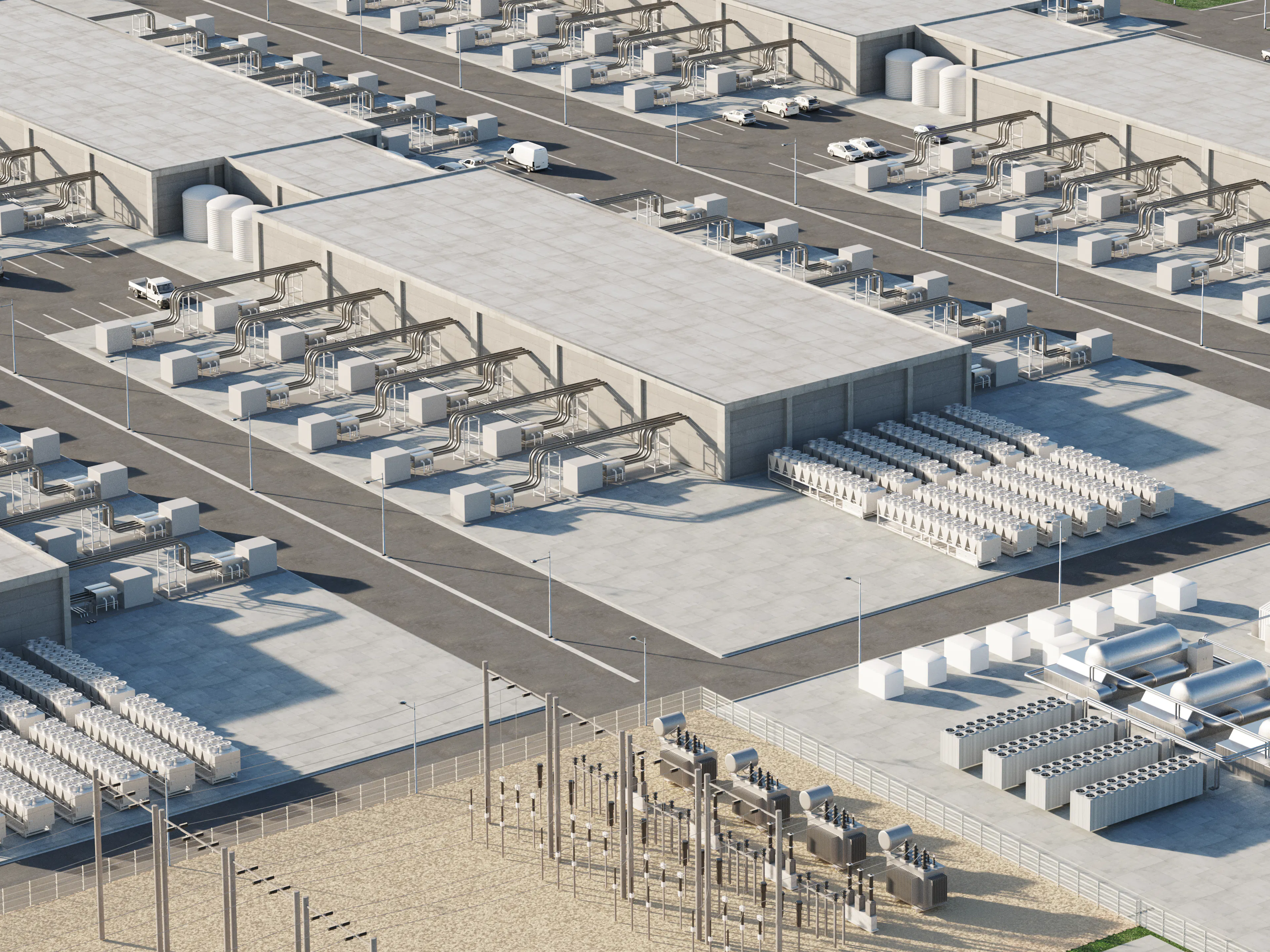
VEIR SL-AC Series – 480 VAC
Superconducting power block and whitespace feeders for 480 VAC data halls. Each VEIR SL-AC Series conductor assembly carries three phases and neutral, replacing a 5,000 A copper busway or duct bank on each 4 MVA feeder.
SL-AC Compact Power Architecture, 72 MW Data Hall
Transformers, generators, and power blocks sit at the building wall, matching how AI data halls are built today. The layout stays the same; only the conductor changes, with SL-AC Series conductor assemblies taking the place of 5,000 A busway feeders indoors and duct bank outdoors.
Download Resource
Loading form...
SL-AC Decoupled Power Architecture, 72 MW Data Hall
Moving the transformers away from the building frees up perimeter space for other equipment and trades. This design is built on a layout that copper’s impedance makes impractical and compares it against the compact copper baseline.
Download Resource
Loading form...
VEIR SL-DC Series – 800 VDC
Superconducting 800 VDC feeders for high-density AI data halls. Each VEIR SL-DC Series conductor assembly carries up to two 6,500 A DC circuits for a total of 10.4 MW capacity, replacing two 6,500A busways on each feeder.
SL-DC Compact Power Architecture, 60 MW Data Hall
Solid-state transformers (SSTs) and generators sit at the building wall, with the battery energy storage system (BESS) beyond the chiller yard. The layout stays the same; only the conductor changes, with dual-circuit SL-DC Series conductor assemblies replacing the copper busway to the whitespace and the duct bank to the BESS.
Download Resource
Loading form...
SL-DC Decoupled Power Architecture, 60 MW Data Hall
Moving the SSTs away from the building frees up perimeter space. Copper’s resistance makes this layout impractical, so the design is compared against the compact copper baseline.
Download Resource
Loading form...
Take the Next Step
These designs are the start of a growing library, with additional architectures in development. If there’s a configuration you want to see engineered, we’d love to hear from you. To get started today, request the full design package or work with VEIR’s engineering team to apply these designs to your specific project. Contact our team at info@veir.com or fill in the form by clicking on contact us below.
Contact Us
Loading form...